
TL;DR:
- Challenging, novel puzzles that push your mental limits provide the greatest brain benefits.
- Crosswords, word searches, Sudoku, and logic puzzles target different cognitive functions.
- Consistent, varied puzzle routines combined with physical activity and social interaction promote healthy aging.
Staying mentally sharp as you age isn't just about eating right or getting enough sleep. Puzzles, surprisingly, may be one of the most powerful tools available. Research confirms that cognitively stimulating activities slow cognitive decline in older adults with mild cognitive impairment. Yet most people underestimate just how much variety, challenge, and consistency matter when choosing the right puzzle. This article walks you through what makes a puzzle genuinely effective, which types deliver the strongest brain benefits, and how to build a routine that keeps your mind working at its best.
Table of Contents
- What makes a puzzle effective for brain health?
- Top types of puzzles for sharpening your mind
- Comparing puzzle options: Which deliver the most cognitive benefits?
- Tailoring your puzzle strategy for best results
- The real secret to staying sharp: Why puzzles alone aren't enough
- Ready to get started? Explore engaging puzzle resources
- Frequently asked questions
Key Takeaways
| Point | Details |
|---|---|
| Challenging puzzles matter | Choose puzzles that offer novelty and proper challenge for the strongest cognitive gains. |
| Consistent practice works | Regular participation in puzzles is linked to improved memory and attention. |
| Variety boosts benefits | Mixing different types of puzzles prevents plateau and keeps your mind engaged. |
| Holistic approach is best | Pair puzzles with physical movement and social connection for lasting brain health. |
What makes a puzzle effective for brain health?
Not every puzzle is created equal. A crossword you can finish in five minutes without breaking a sweat isn't doing your brain many favors. The real cognitive workout happens when a puzzle pushes you just past your comfort zone, forces you to think in new ways, and keeps you engaged long enough to build mental stamina.
Research shows that benefits are highest for puzzles that are challenging, novel, and combined with physical or social activity. That means the puzzle you've been doing the same way for three years may have lost much of its punch. Your brain adapts quickly, and once a task becomes routine, the cognitive gains shrink.
Here's what to look for in a truly effective puzzle:
- Novelty: New themes, unfamiliar words, or fresh formats keep your brain from going on autopilot.
- Appropriate difficulty: Too easy and you coast through. Too hard and frustration takes over. The sweet spot is a puzzle that takes real effort but still feels solvable.
- Variety: Rotating between different puzzle types, like crossword puzzles for adults, word searches, and logic puzzles, prevents the brain from over-relying on one skill set.
- Engagement: If you enjoy it, you'll stick with it. Sustained practice matters more than any single session.
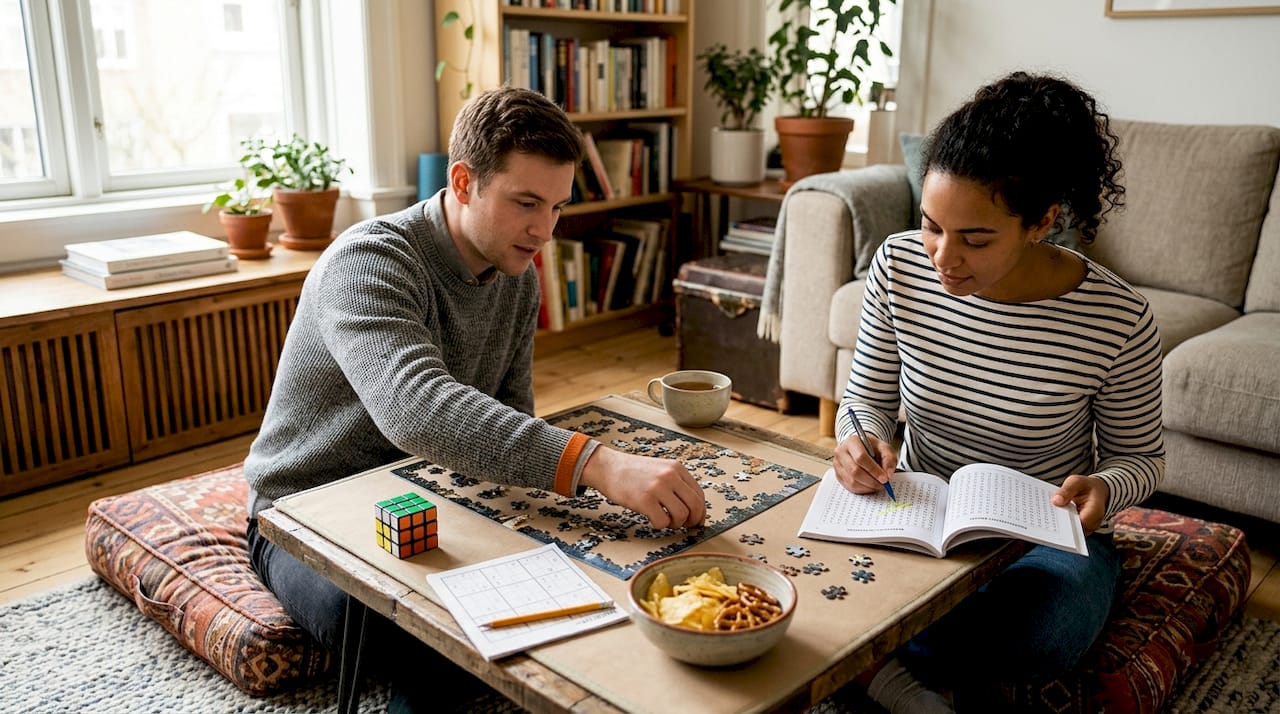
- Social or physical pairing: Doing puzzles with a friend or after a short walk amplifies the mental benefits significantly.
Pro Tip: If you finish a puzzle in under half the time it used to take, that's your signal to level up the difficulty or switch to a new puzzle type entirely.
Beware of products that promise dramatic results from a single app or game. The science is clear that benefits are subtle, build over time, and depend on consistent engagement with genuinely challenging material. There's no shortcut, but the good news is that the process itself can be genuinely enjoyable.
Top types of puzzles for sharpening your mind
With the right criteria in mind, it's time to meet the specific puzzle types that have shown the strongest benefits for adults and seniors.
- Word searches: These train visual scanning, attention to detail, and pattern recognition. Large-print versions are especially accessible for older adults and make daily practice easy and comfortable. Exploring different word search puzzle options lets you find themes that genuinely interest you, which boosts motivation.
- Crossword puzzles: Crosswords work your vocabulary, long-term memory, and verbal reasoning simultaneously. Impressively, crossword puzzles are superior to computerized cognitive training for improving cognition and function in mild cognitive impairment. That's a remarkable finding that puts traditional paper puzzles ahead of many expensive digital tools.
- Sudoku: This number placement game sharpens logical thinking, working memory, and concentration. It requires no math knowledge, just pattern recognition and systematic reasoning, making it accessible to nearly everyone.
- Logic puzzles: Grid-based deduction puzzles and lateral thinking challenges push your brain to hold multiple variables in mind at once. They're excellent for improving planning and problem-solving skills.
- Speed processing games: These timed exercises train how quickly your brain processes and reacts to information. Research on crosswords and brain health and related cognitive training confirms that speed-based practice can have lasting protective effects.
"The best puzzle is the one you'll actually do consistently, but make sure it keeps challenging you. Comfort is the enemy of cognitive growth."
Pro Tip: Look for puzzle books or apps that offer adjustable difficulty levels or rotating content. A puzzle that grows with you provides ongoing challenge without requiring you to constantly search for something new.
Each puzzle type targets different cognitive functions. Word searches build attention and visual processing. Crosswords strengthen memory and language. Sudoku and logic puzzles develop reasoning and concentration. Mixing them throughout your week gives your brain a genuinely well-rounded workout.
Comparing puzzle options: Which deliver the most cognitive benefits?
After exploring the options, it's important to see how they compare in terms of real cognitive impact.
| Puzzle type | Memory | Attention | Reasoning | Language | Research strength |
|---|---|---|---|---|---|
| Word search | Moderate | High | Low | Moderate | Moderate |
| Crossword | High | High | Moderate | High | Very strong |
| Sudoku | Moderate | High | High | Low | Moderate |
| Logic puzzles | High | High | Very high | Low | Moderate |
| Digital brain games | Low to moderate | Moderate | Moderate | Varies | Mixed |
The research tells a compelling story. Crosswords correlated with less brain atrophy and higher cognitive scores compared to other approaches in people with mild cognitive impairment. That's not a small distinction. It suggests that the depth of engagement required by crosswords, pulling from memory, making connections, and working through ambiguity, creates a richer mental workout than many digital alternatives.
For healthy aging adults without cognitive impairment, the picture is more balanced. Here's what the evidence suggests for different groups:
- Adults with mild cognitive impairment: Crosswords show the strongest documented benefits.
- Healthy older adults: A mix of puzzle types, especially those combined with social engagement, provides the broadest protection.
- Adults focused on processing speed: Timed training games show real promise. Speed processing training reduced dementia risk by 25% over 20 years in a major long-term study.
- Adults seeking accessibility: Large-print word searches and simple Sudoku grids offer an easy entry point without sacrificing mental engagement.
You can compare puzzle benefits across formats to find what fits your current cognitive goals and lifestyle. The key takeaway is that no single puzzle type covers every cognitive domain, which is exactly why variety is so important.
Tailoring your puzzle strategy for best results
Understanding the research is just the start. Applying these insights can make your puzzle routine truly powerful.
The most effective approach isn't just picking a puzzle you enjoy and repeating it indefinitely. It's building a strategy that keeps your brain adapting. Start by setting a specific, achievable goal, like completing one puzzle each morning before breakfast, then gradually increase the difficulty every few weeks.
Here's how to build a smarter puzzle routine:
- Mix your puzzle types weekly. Alternate between word searches, crosswords, and logic puzzles to engage different cognitive systems.
- Watch for the practice effect. If a puzzle type starts feeling automatic, your brain has adapted and the benefits are shrinking. That's the time to switch things up.
- Pair puzzles with physical movement. Even a 10-minute walk before sitting down to puzzle can prime your brain for better focus and retention.
- Add a social element. Work through a crossword with a spouse, friend, or neighbor. The conversation and collaboration add a layer of cognitive and emotional benefit that solo puzzling can't match.
- Create a consistent schedule. Your brain responds to routine. Regular daily sessions, even short ones, outperform sporadic marathon sessions.
Research confirms that to maximize benefits, puzzles should be sufficiently challenging, novel, and part of a holistic approach that includes exercise and social engagement. That's not a complicated formula, but it does require intention.
Building daily puzzle habits around your existing routine makes consistency much easier. Morning coffee and a word search. An evening crossword after dinner. Small rituals compound into powerful long-term habits.
Pro Tip: Keep a simple notebook where you log which puzzles you completed and how challenging they felt. Over time, this record becomes a motivating reminder of your progress and helps you spot when it's time to level up.
The real secret to staying sharp: Why puzzles alone aren't enough
Here's the uncomfortable truth that most puzzle enthusiasts don't want to hear: puzzles are a tool, not a cure. The biggest mistake I see is people treating their daily crossword or word search as a complete brain health plan. It isn't.
The most powerful results come when mental challenges are woven into a broader lifestyle. Combining puzzles with physical activity and social connection gives the best results, because puzzles alone are not a miracle fix. That finding aligns with everything we know about how the brain actually thrives.
Easy wins lose their power fast. If you're breezing through the same puzzle format every day, you're essentially on mental autopilot. Real growth happens at the edge of your ability, not in the comfort zone.
Think of puzzles as one vital instrument in a larger orchestra. They contribute something irreplaceable, but the music only works when every section plays its part. Movement, connection, sleep, nutrition, and mental challenge all belong in the picture. When you approach brain health that way, puzzles become genuinely transformative rather than just a pleasant habit.
Ready to get started? Explore engaging puzzle resources
If you're inspired to make puzzles a real part of your brain health routine, finding the right materials makes all the difference. At RCJ Puzzle Books, we create large-print word search puzzle books designed specifically for adults and seniors who want engaging, accessible mental workouts they'll actually look forward to.
Our books come in a range of difficulty levels, so whether you're just starting out or looking for a serious challenge, there's something here for you. Every puzzle is thoughtfully designed to keep your mind active, your attention sharp, and your puzzle time genuinely enjoyable. Explore our full collection and find your next favorite mental workout today.
Frequently asked questions
How often should I do puzzles to see cognitive benefits?
High participation in cognitive games and puzzles sustains cognitive levels, so aim for at least several sessions per week. Consistency over time matters far more than occasional intense sessions.
Are word search puzzles as effective as crosswords or Sudoku?
Crosswords outperform digital cognitive training for cognitive improvement and have the strongest research backing, but word searches and Sudoku still meaningfully boost attention, pattern recognition, and mental agility.
Can doing puzzles really prevent dementia?
Brain training reduced dementia risk by 25% over 20 years in one major study, but puzzles work best as part of a broader healthy lifestyle rather than a standalone solution.
How can I tell if a puzzle is no longer benefiting me?
If you solve puzzles quickly without feeling challenged, novelty and challenge are the keys to continued benefit, so increase the difficulty or switch to a new puzzle type.
Is it better to solve puzzles alone or with others?
Both approaches work well, but combining puzzles with social activity amplifies cognitive benefits and adds emotional rewards that solo puzzling simply cannot replicate.